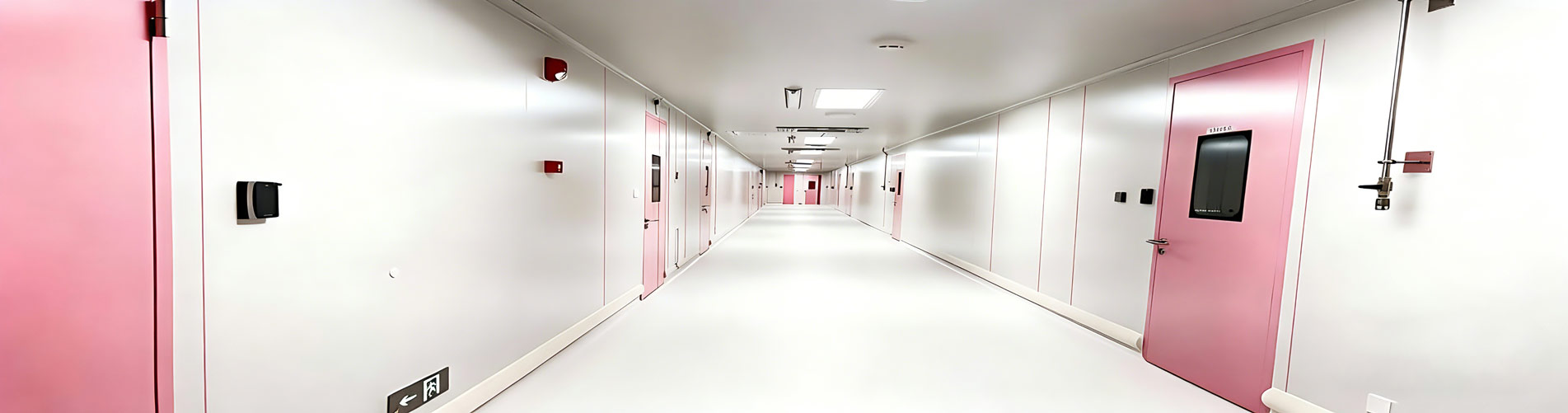
A cleanroom is a controlled environment that strictly regulates the concentration of airborne particles, microorganisms, and chemical contaminants. Its main objectives include:
Modern cleanrooms are primarily defined according to the ISO 14644 system. ISO 5 is equivalent to the traditional Class 100 clean room, meaning a maximum of 100 particles ≥0.5 μm per cubic foot of air. This level is typically applied in high-demand industries such as semiconductor front-end processing, optical manufacturing, and biotechnology.
Relate:WHAT IS A CLEANROOM: A Comprehensive Guide to Core Concepts and Applications
|
ISO Classification |
Maximum Number of Particles in Air |
|||||
|
(Particles in each cubic meter = or>the specified size) |
||||||
|
>0.1 μm |
>0.2 μm |
>0.3 μm |
>0.5 μm |
>1.0 μm |
>5.0 μm |
|
|
ISO 1 |
10 |
- |
- |
- |
- |
- |
|
ISO 2 |
100 |
24 |
10 |
- |
- |
- |
|
ISO 3 |
1,000 |
237 |
102 |
35 |
- |
- |
|
ISO 4 |
10,000 |
2,370 |
1,020 |
352 |
83 |
- |
|
ISO 5 |
100,000 |
23,700 |
10,200 |
3,520 |
832 |
- |
|
ISO 6 |
1,000,000 |
237,000 |
102,000 |
35,200 |
8,320 |
298 |
|
ISO 7 |
- |
- |
- |
352,000 |
83,200 |
2,930 |
|
ISO 8 |
- |
- |
- |
3,520,000 |
832,000 |
29,300 |
|
ISO 9 |
- |
- |
- |
35,200,000 |
8,320,000 |
293,000 |
ISO 5 cleanrooms have strict limits for particles of different sizes:
Therefore, ISO 5 is commonly used for photolithography, development, and critical processes where even the smallest particles can impact quality
ISO 5 cleanrooms typically employ unidirectional (laminar) airflow design. Key design points include:
Airflow management is one of the core ISO 5 cleanroom requirements.
ISO 5 cleanrooms typically use:
Filters are the “last line of defense,” and their performance directly affects whether the cleanroom meets its intended cleanliness level.
Maintaining ISO 5 stability requires strict control of:
These parameters not only affect comfort but also directly influence yield and stability in microfabrication processes.
Materials used in ISO 5 cleanrooms must:
Walls, ceilings, baseboards, and penetrations must have seamless, easy-to-clean construction. Any gaps could become contamination sources.
Since Class 100 clean room and ISO 5 are equivalent, design principles are identical.
Effective layout reduces contamination backflow and cross-contamination:
These factors directly influence whether the cleanroom can maintain its cleanliness level over time.
ISO 5 / Class 100 clean room HVAC and FFU systems require precise control of:
A good HVAC design balances energy efficiency, system stability, noise control, and ensures cleanroom air cleanliness and uniform flow.
Modern ISO 5 cleanrooms increasingly rely on automation and data monitoring:
These systems reduce manual maintenance and help sustain ISO 5 compliance efficiently.
ISO 5 cleanrooms are widely applied in:
All these industries share a high sensitivity to particulate contamination.
Key practices include:
Proper maintenance ensures the cleanroom remains stable long-term, not just compliant in the short term.
ISO 5 cleanrooms typically require:
This ensures ongoing compliance with ISO 14644 standards.
Many in the industry confuse Class 100 clean room and ISO 5, assuming they represent different cleanliness levels. In fact, they are equivalent but defined under different standards.
Understanding this equivalence is crucial for international projects, ensuring compliance with global standards and simplifying verification and certification.
Constructing a high-grade cleanroom that operates stably over the long term requires in-depth understanding and full implementation of ISO 5 cleanroom requirements. From layout, air cleanliness, and filtration to O&M strategies, each element determines whether the cleanroom can truly meet Class 100 clean room standards. Wonclean provides integrated solutions from design, construction, to validation, ensuring cleanrooms not only meet standards but also consistently support production and R&D activities over time.

 Room JT30151, Building 4, Area B, No. 925 Yecheng Road, Industrial Zone, Shanghai,China
 info@wonclean.com
Allen@wonclean.com
Joy@wonclean.com
info@wonclean.com
Allen@wonclean.com
Joy@wonclean.com
 +8613671979988(Allen)+86 15950938878(Joy)


 online service

