







Electronics and semiconductor production is uniquely vulnerable to something invisible: static electricity. A static-discharge event far below the level a person can perceive can degrade or destroy a sensitive component, and a charged surface quietly pulls airborne particles toward the very products a cleanroom exists to protect. Controlling that charge is not only a matter of wrist straps and flooring — the walls themselves are part of the system.
This article looks at why electrostatic discharge (ESD) matters so much in electronics cleanrooms, how surface behaviour is classified, and how to specify antistatic cleanroom wall and sandwich panels that contribute to control rather than working against it.
01 — The core problem
Why static is a double threat in electronics cleanrooms
Static causes two distinct problems, and an electronics cleanroom has to solve both at once.
The first is electrostatic discharge damage. Modern integrated circuits, sensors and printed assemblies operate at tiny voltages and feature geometries measured in nanometres. A sudden discharge — from a person, a tool or a charged surface — can puncture insulation layers or fuse conductors. Many devices are damaged by events under 100 volts, well below the roughly 2,000 volts a person needs before they feel a shock. The damage is often latent: the part survives the line and fails in the field.
The second problem is electrostatic attraction. A charged surface acts like a magnet for airborne particles, pulling them out of the airflow and holding them where they can settle on a wafer or board. In a room engineered to keep particles moving and away from the product, a charged wall does the opposite. Both problems point to the same requirement: surfaces should let charge bleed away to ground in a controlled way, instead of building it up.
02 — The science
Conductive, dissipative, insulative: what the numbers mean
ESD behaviour is described by surface resistance, measured in ohms and grouped into bands by standards such as IEC 61340-5-1 and ANSI/ESD S20.20. The goal for most cleanroom surfaces is the middle band — static-dissipative — which lets charge drain away in a controlled, non-violent way rather than either holding it or releasing it in a sudden spark.
| Behaviour | Approx. surface resistance | What it does |
|---|---|---|
| Conductive | 10² – 10⁵ Ω | Drains charge very quickly; used where fast, direct grounding is wanted |
| Static-dissipative | 10⁵ – 10⁹ Ω | Drains charge in a controlled, gradual way — the usual target for surfaces |
| Antistatic / low-charging | up to ~10¹¹ Ω | Resists generating charge in the first place |
| Insulative | > 10¹² Ω | Holds charge — the behaviour to avoid on large cleanroom surfaces |
The lesson for the envelope is simple: a plain painted or laminate wall can be highly insulative, behaving exactly the way you do not want. An ESD-aware cleanroom specifies surfaces whose finish and grounding place them in the dissipative band, so the walls participate in charge control instead of undermining it.
03 — The selection
Choosing antistatic wall and sandwich panels
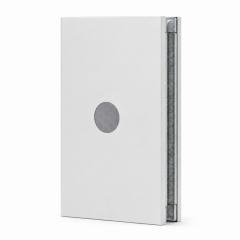
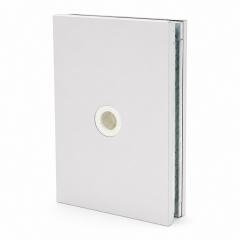
A cleanroom sandwich panel is built from two metal facings bonded to an insulating core. For ESD performance, the part that matters is the facing and its finish, plus how the panel is grounded — not the core. That means you can choose the core for the properties it governs (structure, fire, insulation) and treat the surface separately for static control.
The face
The visible surface should be smooth, cleanable, non-shedding and given an antistatic or static-dissipative finish — a coated steel facing or an antistatic HPL, rather than a standard insulative laminate. This keeps the large wall area in the dissipative band while still meeting the cleanroom requirement for a wipe-clean, particle-free surface.
The core
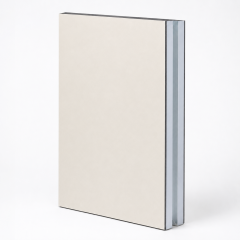
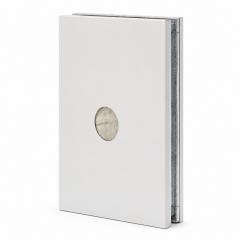
The core is chosen for everything else. Rock wool and magnesium-oxide cores bring fire performance and rigidity; aluminium honeycomb gives a light, very flat panel; polyurethane offers thermal insulation. The cut-away below shows a typical rock-wool-cored cleanroom panel — a smooth, sealed face over a structural, fire-resistant core.

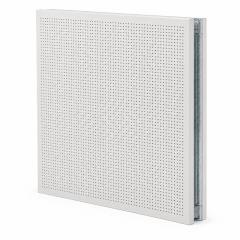
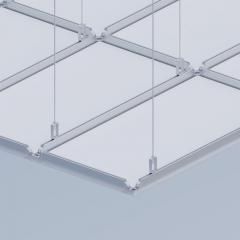
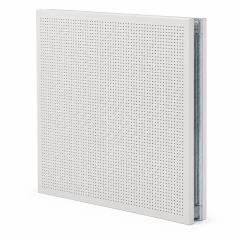
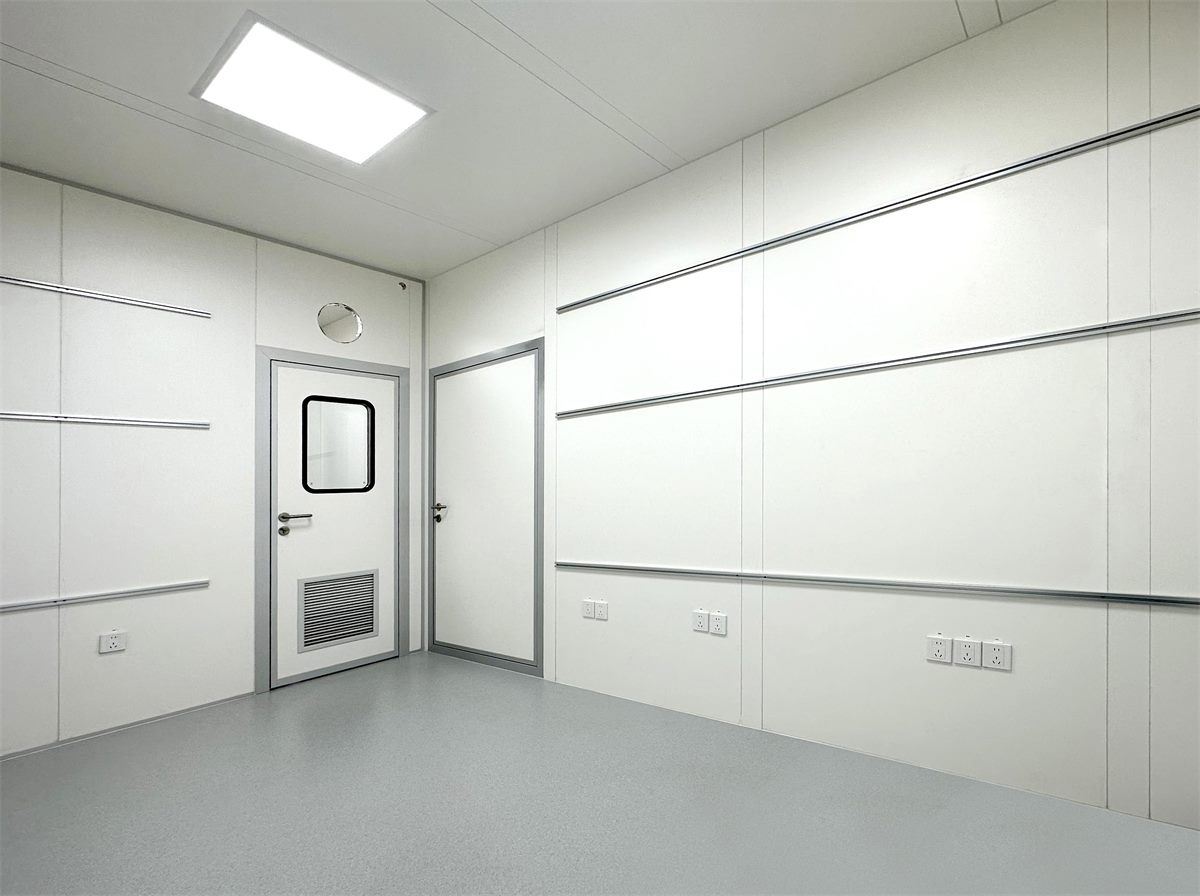
Beyond the panel itself, the same surface logic applies to the matching cleanroom panels used for ceilings and to doors and windows, so the whole envelope behaves consistently.
04 — The detail that makes it work
Grounding: turning panels into a charge path
A dissipative surface only controls static if it has somewhere to send the charge. The defining detail of an ESD-aware envelope is therefore bonding and grounding: the wall and ceiling panels, the floor and the supporting framework are all electrically connected to a common ground, so charge anywhere on the surface has a continuous, low-stress path to earth.
Schematic — panels, ceiling and floor bonded to a single earth reference.
Practically, this means specifying grounding points and bonding hardware as part of the panel system, designing the joints so the connection is continuous, and verifying surface resistance after installation. A wall that tested as dissipative on a sample but was never grounded on site provides no protection at all.
05 — Putting it together
The rest of the envelope still has to be a cleanroom
ESD control never overrides the basic cleanroom requirements — it sits on top of them. The same clean room walls still have to be smooth, sealed, non-shedding and cleanable, with coved, gap-free junctions that leave no corners for particles. The antistatic finish has to survive routine cleaning and disinfection without losing its dissipative property, and the panels must still meet the project’s fire and structural needs through the core.
This is why an electronics cleanroom envelope is best specified as one coordinated system: facing, core, finish, doors, windows and grounding chosen together. When surface resistance, cleanability and fire rating are balanced in a single panel specification, the walls quietly do their job — protecting devices and product without anyone noticing them.
Key takeaways
- Static is a double threat in electronics cleanrooms: it damages devices and attracts particles.
- The target for surfaces is the static-dissipative band (roughly 10⁵–10⁹ Ω), not insulative.
- In a sandwich panel, ESD performance comes from the face finish and grounding — choose the core for fire, structure and insulation.
- Bonding and grounding every surface to a common earth is what makes a dissipative wall actually work.
- Antistatic panels must still meet all the usual cleanroom requirements for cleanability, sealing and fire.
Specifying an electronics cleanroom envelope?
Wonclean supplies antistatic cleanroom wall and sandwich panels, ceilings, doors and windows — engineered together, with grounding designed in — for electronics and semiconductor environments. Share your ESD target and cleanliness class and our engineers will help you specify the system.
FAQ


 online service

