What are you looking for?
Technical Article | Pharmaceutical / Medical
Use container laboratory design to create temporary QC clean spaces during pharma renovation, coordinating cleanroom panels, HVAC, utilities, sample flow and validation interfaces.
cleanroom wall system cleanroom doors air shower room pass box
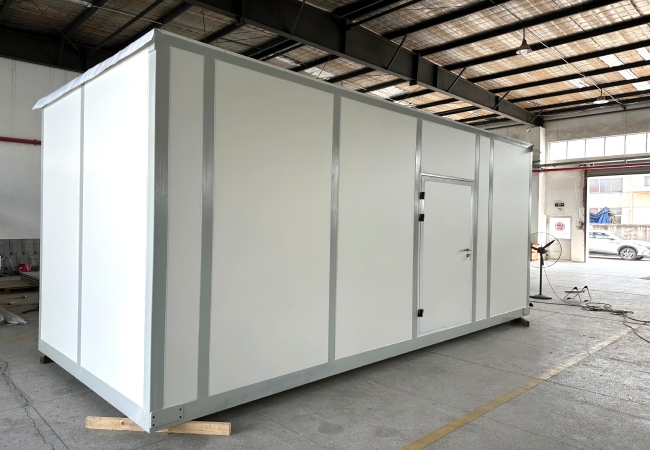
A pharmaceutical renovation project often has two competing demands: the plant must improve, expand or repair its facility, but routine quality control cannot simply disappear. A temporary QC laboratory can protect sample testing continuity during shutdown windows, phased construction or equipment replacement. Container laboratory design is useful in this situation because it packages the cleanroom envelope, HVAC routes, doors, service panels and utility interfaces into a controlled module that can be prepared before the main renovation reaches its busiest phase.
Technical References Used
This article references EU GMP Annex 1 for contamination control principles, ISO 14644-1 for cleanroom classification, ISO 14644-2 for monitoring evidence, ISO 14644-4 for design and start-up, and FDA Process Validation guidance for lifecycle qualification and change control thinking.
Renovation Challenge
A temporary QC space may operate for weeks or months, but every sample result can still support batch disposition, environmental trending, cleaning verification or investigation work. That means the temporary laboratory must be planned under the same quality mindset as a permanent room. The containerized laboratory does not have to copy the permanent lab in every detail, but it must protect sample integrity, traceable workflows and controlled access.
The first decision is scope. Some renovation projects only need sample receipt and documentation. Others need preparation benches, incubator staging, retained sample handling, equipment calibration support or environmental monitoring processing. Once scope is defined, the container laboratory can be divided into clean zones, support zones and service zones, with doors and pass-throughs placed according to actual sample flow.
| Decision | What to define | Why it matters |
|---|---|---|
| Operating purpose | Temporary QC testing, environmental monitoring support, sample preparation or document/control point. | Prevents oversizing or under-designing the cleanroom module. |
| Clean zones | Room sequence, pressure direction, transfer doors, pass box positions and gowning expectations. | Controls sample flow and limits construction-area contamination risk. |
| HVAC | HEPA filtration, air change strategy, temperature/humidity limits and exhaust need. | Supports ISO 14644 classification and stable laboratory operation. |
| Utilities | Power, data, water, drain, compressed air, gas and emergency interfaces. | Determines whether the module can be connected quickly without unsafe site improvisation. |
Cleanroom Envelope
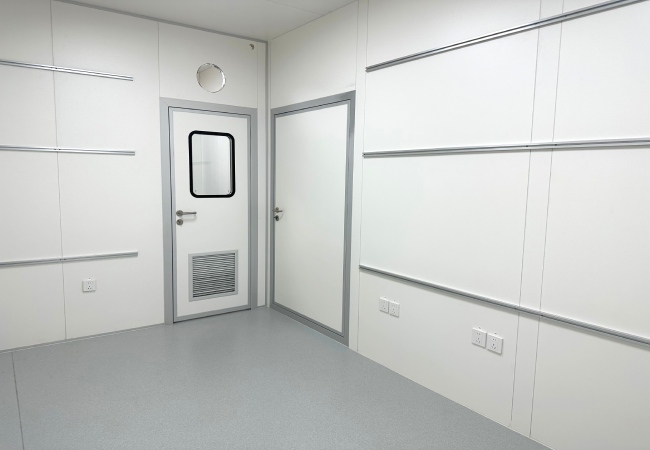
A containerized laboratory is more constrained than a conventional room. Every wall section has to carry more responsibility because benches, utilities, door swings, pressure instruments and service access are compressed into a smaller footprint. Cleanroom wall panels should be selected for flatness, cleanability, impact resistance, seal compatibility and the ability to receive planned penetrations without field cutting chaos.
Cleanroom doors are equally important. A door in a temporary QC lab may serve as a contamination boundary, a logistics route and an emergency exit at the same time. Hinges, frames, seals, locksets and vision windows must be coordinated with pressure direction and operator movement. If the module uses multiple rooms, the door sequence should support a practical pressure cascade rather than just a neat floor plan.
HVAC and Utilities
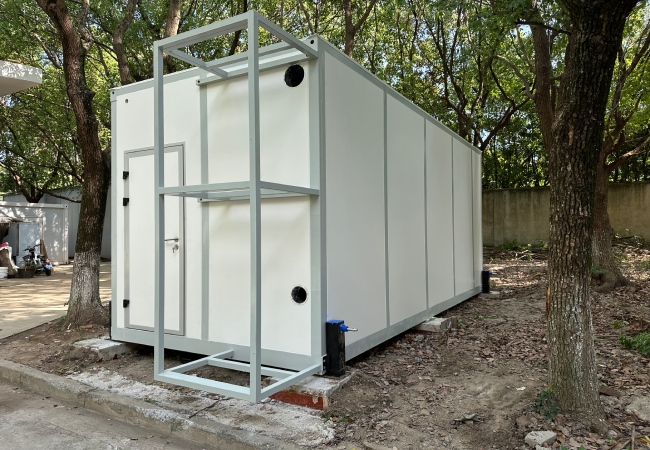
Many temporary cleanrooms fail because the module is physically complete but not operationally connectable. A container laboratory should have an early utility matrix that shows incoming power, drainage, water, compressed air, data, HVAC condensate, exhaust, alarm outputs and future tie-ins. The interface points should be accessible from a service side, not hidden behind benches or finished panels.
HVAC deserves special attention during renovation projects. The temporary lab may sit near active construction, outdoors, in a warehouse bay or beside an operating building. Dust, temperature swings, access restrictions and noise constraints can all affect performance. ISO 14644-4 is useful here because it frames cleanroom design as a system that moves through design, construction and start-up, not just a room with filters.
For sample preparation and QC support, HEPA filtration alone is not enough. The module needs balanced airflow, pressure verification, stable environmental conditions, sensor access, alarm logic and a defined response when values drift. These details should be addressed in the qualification plan before the temporary lab is needed urgently.
Deployment Flow
Risk Control
The most common mistake is treating the container laboratory as a shortcut around engineering review. A temporary lab still needs a user requirement specification, design review, change control, commissioning, qualification and operating SOPs. The second mistake is selecting the container first and forcing the workflow into it later. The cleaner approach is to start with the sample flow and then size the module.
The third mistake is ignoring the renovation boundary. If the temporary lab is placed too close to construction dust, waste routes or uncontrolled personnel traffic, its cleanroom envelope has to fight the site every day. Access paths, protective barriers, material transfer and cleaning frequency should be decided at the same time as the module location.
Confirm URS, sample flow, room sequence and utility list.
Inspect panels, doors, penetrations, HVAC openings and documentation.
Verify installation, pressure direction, monitoring points and operator SOPs.
Technical Fact Check
A containerized laboratory can provide temporary QC or sample preparation space during renovation when layout, HVAC, cleanroom envelope, utilities and qualification are planned together. ISO 14644 and GMP guidance support risk-based cleanroom design and monitoring.
This article does not state that every container laboratory is GMP-ready by default. Final cleanroom grade, pressure values, qualification acceptance criteria and allowed test activities must be defined by the owner and verified before use.
FAQ
Yes, if the temporary QC activities are defined and the module is designed, connected and qualified for those activities before use.
The article targets containerized laboratory, containerized lab modules and container laboratory design for pharmaceutical renovation and temporary QC applications.
The biggest risk is a mismatch between the temporary workflow and the physical module, especially around HVAC, utilities, pressure direction and sample transfer.

 Room JT30151, Building 4, Area B, No. 925 Yecheng Road, Industrial Zone, Shanghai,China
 Info@wonclean.com
Allen@wonclean.com
Joy@wonclean.com
Info@wonclean.com
Allen@wonclean.com
Joy@wonclean.com
 +86 13671979988(Allen)+86 15950938878(Joy)


 online service

