


Cleanroom Installation Guide for Better Cleanroom Design and Construction, Maintenance, and Long-Term Performance
A reliable cleanroom installation should be planned as part of the full project lifecycle, not treated as the final step after procurement. For ISO/GMP projects, good cleanroom design and construction connects wall panels, ceiling grids, HVAC, air shower, pass box, cleanroom door, and cleanroom window decisions with long-term cleanroom maintenance access, pressure stability, and future expansion requirements.
Which Cleanroom Projects Need Lifecycle Planning Instead of Component Buying?
Cleanroom lifecycle planning is most valuable when the project must maintain stable cleanliness, pressure, and maintenance access after handover. Pharmaceutical, medical device, biotechnology, semiconductor, food packaging, and precision instrument facilities often face project risks when cleanroom components are purchased separately without checking how the enclosure, airflow, access control, and maintenance route will work together.
A cleanroom project should be selected by process risk, not by room size alone. ISO Class 5, ISO Class 7, and ISO Class 8 rooms may require different airflow intensity, filtration coverage, pressure cascade, and cleaning access, while GMP Grade B/C/D environments also need practical control of personnel movement, material transfer, and contamination risk. Buyers should align their project target with ISO 14644 cleanroom classification before finalizing room layout and equipment interfaces.
What Technical Parameters Should Be Confirmed Before Cleanroom Installation?
Buyers should confirm core performance parameters before cleanroom installation begins because late decisions can create field rework and unstable operation. The minimum review should include cleanliness class, ACH air changes per hour, differential pressure, temperature, relative humidity, HEPA or FFU layout, return-air path, door-opening frequency, and recovery expectation after personnel or material movement.
Pressure control is one of the most important early decisions. Many ISO/GMP cleanroom projects use a room-to-room differential pressure reference of 10–15 Pa, but the final pressure cascade should match the process risk, adjacent room grade, and door-opening pattern. If the wall system, ceiling grid, doors, pass boxes, and HVAC are not coordinated, the room may meet the drawing requirement but still suffer pressure drift during daily operation.
Temperature and humidity should also be treated as technical design inputs. A common working reference for many controlled environments is 20–24°C and 45–60% relative humidity, but the final values should follow product sensitivity, operator comfort, equipment heat load, and process requirements. These targets affect HVAC sizing, panel insulation, condensation risk, ceiling service space, and long-term cleanroom maintenance workload.
How Does Cleanroom Design and Construction Affect Installation Speed?
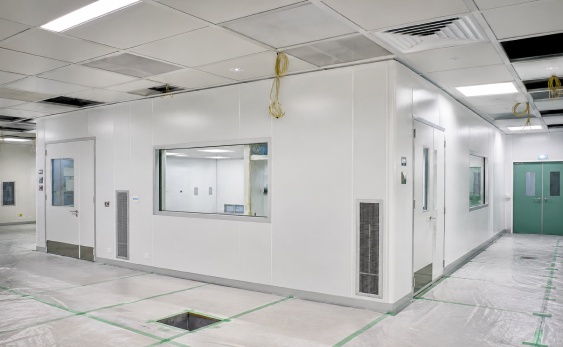
Cleanroom design and construction affect installation speed because every late interface change increases cutting, sealing, dust generation, and coordination work on site. A modular approach can reduce installation uncertainty when cleanroom partition panels, ceiling grid modules, door frames, window openings, pass box sleeves, utility penetrations, and HVAC interfaces are confirmed before production.
The fastest installation is not always the best installation. A cleanroom can be assembled quickly but still create long-term problems if panel joints are not sealed correctly, ceiling access is blocked, return air is poorly positioned, or cleanroom doors interfere with material flow. Project teams should review installation efficiency together with pressure recovery, cleaning access, and future modification needs.
Why Do Wall Panels, Ceiling Grid, HVAC, Doors, and Pass Boxes Need System Coordination?
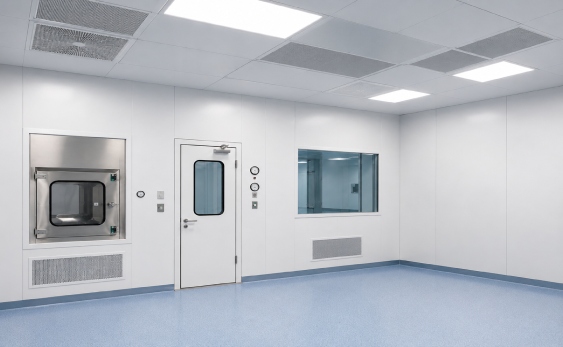
Cleanroom components need system coordination because contamination control depends on the interaction between surfaces, airflow, access, and maintenance. Cleanroom partition systems and modular wall panels provide the sealed envelope, the cleanroom ceiling grid supports FFU or HEPA filtration, HVAC controls airflow and pressure, while air showers and pass boxes manage personnel and material transfer routes.
A cleanroom ceiling grid should be reviewed before installation because filter layout, LED panels, maintenance panels, sprinkler points, and HVAC terminals all compete for ceiling space. Common FFU and ceiling modules may use 1200×1200 mm or 1200×600 mm coordination, depending on airflow coverage and service access. If the ceiling grid is planned too late, the project may face filter misalignment, hard-to-access maintenance zones, or uneven airflow distribution.
Cleanroom doors, cleanroom windows, air showers, and pass boxes should also be reviewed as pressure and cleaning interfaces. A sealed frame, flush window, cleanable surface, and correctly sequenced pass box can help reduce particle traps and uncontrolled air exchange. When Wonclean coordinates these systems with modular installation drawings, the project can reduce avoidable interface conflicts before site work begins.
What Procurement Mistakes Create Cleanroom Maintenance Problems Later?
The most common procurement mistake is selecting cleanroom materials only by purchase price. A lower-cost panel, door, or ceiling detail may increase maintenance cost if it creates difficult cleaning, weak sealing, poor impact resistance, corrosion risk, or restricted access to filters and utilities. Cleanroom maintenance should be considered during procurement because every hidden service point can become a future shutdown risk.
Another mistake is ignoring future expansion. Many cleanroom projects start with one production area and later need additional packaging, testing, storage, or laboratory zones. If the cleanroom design and construction phase does not reserve utility capacity, removable partition logic, ceiling access, and future door positions, later expansion may require unnecessary demolition and longer downtime.
Buyers should also avoid separating installation drawings from maintenance drawings. Maintenance teams need to know where HEPA filters, FFU units, pressure sensors, return-air grilles, electrical routes, and sealed access panels are located. A cleanroom that is easy to install but hard to maintain can become expensive during filter replacement, leakage inspection, pressure adjustment, and routine cleaning.
Which Buyer Checks Reduce Lifecycle Risk?
Buyers can reduce lifecycle risk by connecting each procurement question to a measurable engineering check. The goal is not to buy more equipment, but to confirm that the cleanroom installation, enclosure, airflow, access control, and cleanroom maintenance strategy can work together after handover.
| Buyer Question | Recommended System | Key Check | Risk If Ignored |
|---|---|---|---|
| Need faster cleanroom installation? | Modular cleanroom system | Prefabrication scope and interface drawings | Site cutting and schedule delay |
| Need stable pressure control? | HVAC and pressure cascade | 10–15 Pa reference and return-air route | Pressure drift during operation |
| Need cleanable enclosure surfaces? | Wall panels and cleanroom partition | Sealed joints and flush interfaces | Leakage and dirt traps |
| Need reliable filter maintenance? | Cleanroom ceiling grid and FFU layout | 1200×1200 / 1200×600 mm access logic | Difficult HEPA replacement |
| Need cleaner material transfer? | Pass box and airlock route | Interlock, door sequence, transfer frequency | Cross-contamination risk |
| Need lower future retrofit cost? | Reusable modular wall system | Expansion path and spare utility capacity | Long shutdown and high rework cost |
Can Modular Installation Improve Long-Term Cleanroom Maintenance?
Modular installation can improve long-term cleanroom maintenance when the system is designed for access, replacement, and future modification from the beginning. Removable wall panels, coordinated ceiling service zones, accessible FFU modules, visible pressure monitoring points, and cleanable door and window frames can help maintenance teams work without disturbing adjacent clean areas unnecessarily.
Maintenance-friendly design should include clear access to filters, dampers, pressure sensors, lighting, pass box controls, door interlocks, and sealed panel joints. This is especially important in ISO Class 7 and ISO Class 8 production support areas where routine cleaning, filter changes, and pressure checks must be performed without creating repeated contamination-control interruptions.
Wonclean can support lifecycle planning by coordinating cleanroom design and construction with modular cleanroom installation details, wall panel systems, ceiling grid layouts, cleanroom doors, cleanroom windows, air showers, pass boxes, HVAC integration, and maintenance access planning. The practical value is a cleaner installation workflow, fewer interface conflicts, and a more serviceable cleanroom after operation begins.


 online service

