


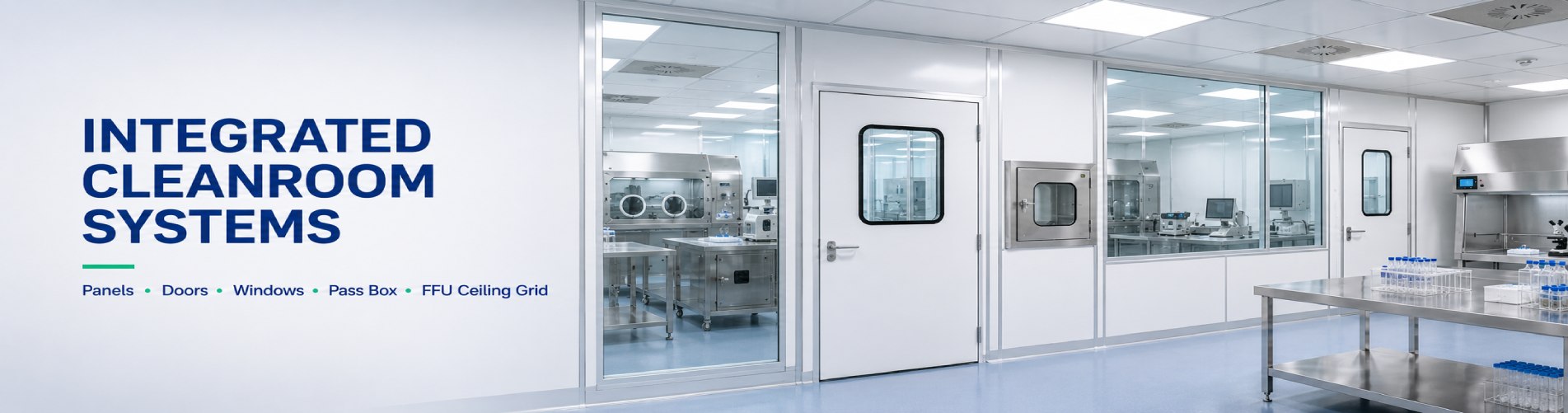
“How much does a cleanroom cost?” is the most common question we get — and the hardest to answer in one number. The honest reply is “it depends,” but that is not very useful when you are trying to set a budget. So this guide does the opposite: it gives you real ranges, explains exactly what pushes the figure up or down, and shows you how to compare quotes on a fair basis.
If you are scoping a project and just need a defensible budget line, you are in the right place. We will keep it practical and vendor-neutral, and point you to the deeper technical reading where it helps.

The short answer
What a modular cleanroom costs per square metre
Cleanroom budgets are almost always compared per square metre of cleanroom floor area, because that lets you size a project before the design is finished. As a 2026 industry rule of thumb, a turnkey modular cleanroom — envelope, ceiling, airflow and filtration installed — typically falls in these bands:
| Cleanliness class | GMP grade | Typical use | Indicative cost (USD / m²) |
|---|---|---|---|
| ISO 8 | Grade D | General assembly, packaging | $800 – $1,500 |
| ISO 7 | Grade C | Medical devices, electronics | $1,200 – $2,200 |
| ISO 6 | — | Optics, precision electronics | $1,800 – $3,000 |
| ISO 5 | Grade A / B | Sterile fill, semiconductor | $2,500 – $5,000+ |
Indicative ranges for budgeting, excluding process equipment. Actual quotes vary by region, size, HVAC and specification.
A softwall cleanroom or a cleanroom booth can sit below these bands; a fully fitted, equipment-loaded suite can sit well above them. Treat the table as a starting point, not a quote.
The detail
The 7 things that move a modular cleanroom price
Two cleanrooms of the same size can differ in price by 3× or more. Almost all of that gap comes down to seven variables:
- 1. Cleanliness class. The biggest lever. A higher ISO class means more filter coverage, more air changes per hour and tighter construction — all of which cost money. Going from ISO 8 to ISO 5 can more than double the per-m² figure.
- 2. Floor area and layout. Larger rooms cost more in total but usually less per m². Lots of small rooms, airlocks and gowning spaces add walls, doors and controls, raising the average.
- 3. HVAC and air handling. Often 30–50% of the build. Air-change rate, temperature, humidity control and redundancy drive the size — and the price — of the system. Hot, humid climates push this higher.
- 4. Envelope materials. The wall and ceiling panels you choose — rockwool, MgO, aluminium honeycomb or HPL — change both cost and performance. See our note on cleanroom sandwich panels for the trade-offs.
- 5. Equipment and fit-out. Pass boxes, air showers, FFUs, lighting, benches and monitoring add up quickly, and process/production equipment (not counted in our table) is often the single largest line in the whole project.
- 6. Compliance and validation. GMP documentation and IQ/OQ/PQ qualification add engineering and paperwork. The stricter the regime (for example EU GMP Annex 1), the higher this cost.
- 7. Location, logistics and install. Shipping, site access, local labour and lead time all matter — which is one reason prefabricated and containerized approaches can be cost-effective on remote or fast-track sites.
Comparison
Modular vs traditional construction: where the money goes
Buyers often ask whether modular is cheaper than a conventional “stick-built” cleanroom. On the raw panel-and-steel line, the two are comparable. The savings show up around it — in time, predictability and reuse.
| Factor | Modular cleanroom | Traditional build |
|---|---|---|
| Upfront unit cost | Comparable | Comparable |
| Build / install time | Weeks (factory + site in parallel) | Months (sequential trades) |
| Cost certainty | High (factory-priced) | Variable (site overruns) |
| Disruption to site | Low | High |
| Reconfigure / relocate | Designed for it | Difficult / costly |
| Future resale value | Retained (movable asset) | Low (fixed to building) |

For the engineering behind why a modular ceiling and airflow design performs the way it does, see our technical piece on environmental control in GMP cleanrooms.
Practical
How to read a modular cleanroom quote
When the prices come in, compare them on the same basis with this quick checklist:
- Same class and area? Confirm every quote is for the same ISO class and the same usable floor area.
- What is in / out? Check whether HVAC, controls, doors, FFUs, flooring, validation and freight are included or excluded.
- Lead time and install. A lower price with a far longer lead time may cost more once downtime is counted.
- Documentation. Ask what qualification paperwork (IQ/OQ/PQ) is provided for your regulator.
- After-sales. Spare parts, filter supply and service availability in your region.
Key takeaways
- Budget modular cleanrooms per m²: roughly $800–$5,000+/m² depending mainly on ISO class.
- Cleanliness class and HVAC are the two biggest cost drivers.
- Modular and traditional cost similarly on units, but modular wins on time, certainty and reuse.
- Separate CAPEX from OPEX — energy, filters and recertification are real lifetime costs.
- Compare quotes on identical scope, not just the headline number.
Want a real number for your project?
The ranges above are for budgeting. For an actual modular cleanroom price, share your target ISO class, floor area and location, and Wonclean’s engineers will put together a scoped, itemised quote — so you can see exactly what is in it.
FAQ


 online service

