


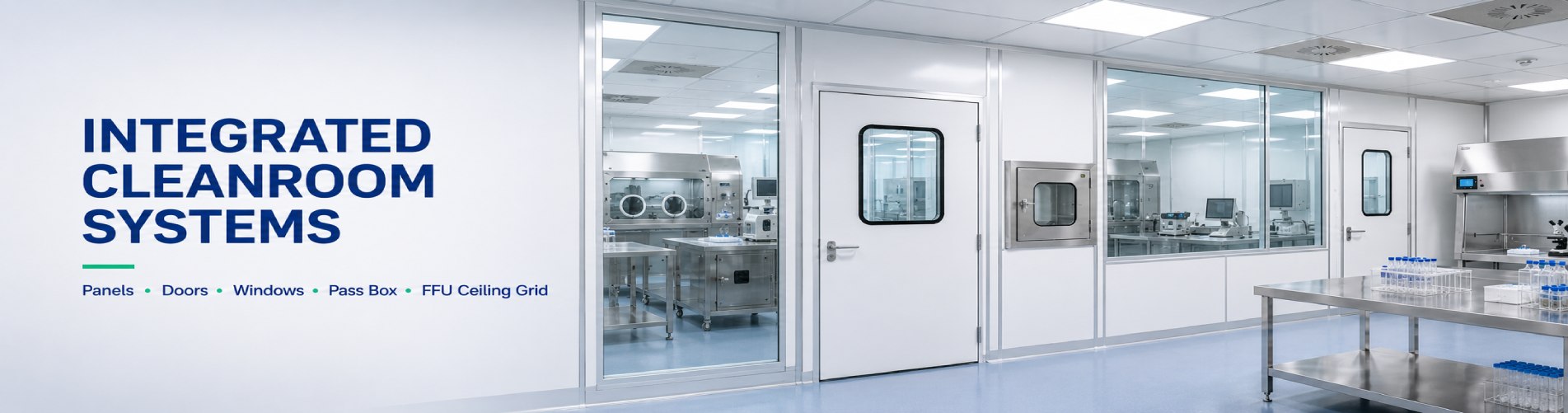
How to Evaluate Modular Cleanroom Infrastructure via 2026 ISO and GMP Standard Guidelines?
Sustaining a validated, sterile processing environment under updated Annex 1 GMP regulations requires deploying an adaptive, heavy-duty cleanroom ceiling grid that eliminates structural deflection over high-vibration manufacturing zones. To shield vulnerable open-product handling lines from localized microbial vectors, operators integrate a specialized Clean Laminar Flow Hood assembly to maintain unidirectional airflow parameters. This localized protection is supported by a comprehensive, facility-wide cleanroom air purification loop designed to cycle out microparticulates before they breach critical wall boundaries. Engineering managers can review a real-world, scalable deployment roadmap in our latest global project case detailing the physical execution of zero-leak containment barriers.
What Are the Technical Evaluation Criteria for 2026 Modular Cleanroom Components?
Modern facility evaluation guidelines focus on minimizing operational downtime while enforcing strict particulate containment. When selecting structural profiles, engineers must balance initial capital expenditures against ongoing maintenance accessibility. This comparison becomes critical during commercial scale-up operations where structural integrity dictates long-term batch validation success rates.
| Cleanroom Engineering Parameter | Standard Light-Duty Grid Setup | Wonclean Heavy-Duty Integrated Grid | Primary Operational Advantage |
|---|---|---|---|
| Walkable Interstitial Load Limit | Less than 80 kg/m2 (Non-walkable) | Over 150 kg/m2 Safe Walkable Limit | Allows safe overhead servicing without stopping production downstairs. |
| Airway Boundary Seal Efficiency | Standard liquid glue / PVC gaskets | Dual-Layer High-Elasticity Gel Seal | Prevents bypass leakage around FFUs during aggressive pressure shifts. |
| Chemical Wipe Down Tolerance | Gradual powder coat oxidation | High-Density HPL Layer Protection | Zero blistering or micro-cracking during persistent VHP cycles. |
| Asset Modification Downtime | 14 to 21 Working Days | 2 to 3 Working Days (Modular Hook) | Accelerates facility layout shifts during corporate expansions. |
Why Do Walkable HPL Systems Lower Lifetime Operational Overhead?
Traditional civil cleanrooms often require complete structural dismantling when an FFU motor fails or when localized air tracking requires physical rebalancing. Utilizing a reinforced modular structural layout shifts the entire maintenance workflow to the interstitial mechanical crawlspace located above the ceiling plane. This structural separation keeps the lower production floor completely clean, saving thousands of dollars in re-validation and environmental testing costs.
Which Air Purification Strategies Prevent Pressure Cascade Degradation?
Maintaining the integrity of positive pressure cascades across multiple interconnected rooms requires a tightly controlled mechanical boundary. When localized filter configurations face sudden changes in ambient resistance, smart electronic-commutated (EC) fan networks adjust their output torque in real time. This automated correction counteracts static pressure decay, ensuring that lower cleanliness classifications never backflow into sterile filling spaces.


 online service

